The Hidden Leadership Debt Slowing Your Organization

Dana Campbell, PCC
Why avoiding micromanagement isn't enough—and how leadership calibration determines whether your organization builds capability or creates drag.
TL;DR
Most organizations don't have a micromanagement problem.
They have a leadership calibration problem.
In trying to avoid micromanagement, leaders often create leadership debt—taking work back themselves, avoiding difficult coaching conversations, or stepping so far away that clarity and accountability suffer.
The highest-performing organizations don't eliminate oversight. They calibrate it. The result is stronger leaders, better execution, and organizations that build capability instead of dependency.
Most executive teams we work with are trying hard to eliminate micromanagement.
That's a good thing.
Research has consistently shown that excessive oversight comes at a real cost. A Robert Half survey found that nearly six in ten employees have worked for a micromanager. Of those, 68% said it reduced morale and 55% said it hurt their productivity. More recent research, including a 2025 systematic review published in SAGE Journals, found that highly controlling leadership reduces employees' willingness to take initiative, experiment, and go beyond their defined responsibilities—the very behaviors organizations depend on for innovation and speed.
It's no surprise that executives have spent years trying to eliminate micromanagement.
The problem is, that's only half the equation.
As Harvard Business Review has argued, the opposite of micromanagement isn't necessarily effective leadership. Under-management can be just as damaging when leaders avoid difficult conversations, fail to establish accountability, or step back so far that teams lose clarity and direction.
I think we've become so focused on eliminating micromanagement that we've overlooked a much bigger organizational challenge. We're teaching leaders what not to do. We're spending far less time teaching them how to intentionally calibrate their involvement.
The result is what I call leadership debt. Leadership debt is the hidden cost organizations incur when leaders solve today's execution problems at the expense of tomorrow's organizational capability.
Like financial debt, it often feels productive in the moment.
The work gets done.
The deadline is met.
The customer is happy.
But interest compounds over time—in weaker leaders, greater dependency, slower decisions, inconsistent execution, and executives who become increasingly trapped in work they should have delegated long ago.
That's organizational drag.
Leadership isn't binary. It's a calibration problem.
One of the biggest mistakes I see organizations make is treating leadership as a choice between two extremes.
Either you micromanage. Or you empower. Control or trust. Hands-on or hands-off.
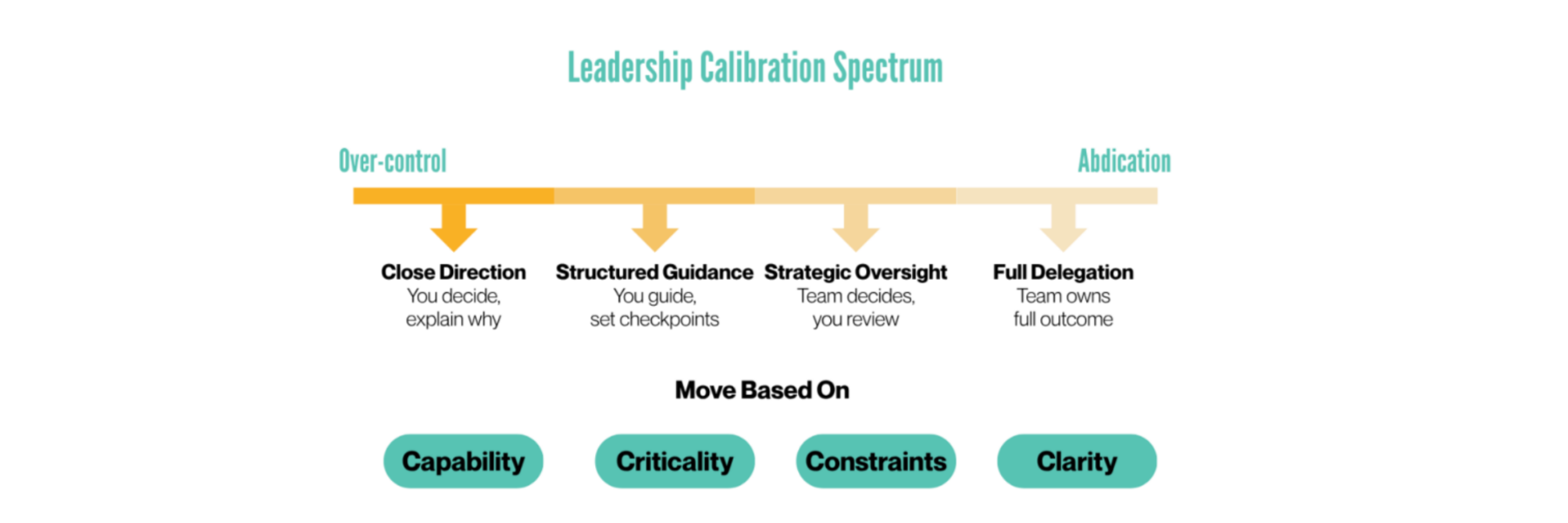
Leadership doesn't work that way. I think of leadership oversight as a spectrum.
On one end is Over-Control. Leaders are involved in every decision, every deliverable, every meeting. Over time, people stop exercising judgment because the organization has conditioned them to wait for approval before moving. Decisions slow, ownership declines, and leaders become the bottleneck.
On the opposite end is Abdication. Work is delegated without enough structure. Expectations remain fuzzy. Success isn't clearly defined. There are few meaningful checkpoints. Leaders mistake distance for empowerment, and trust becomes indistinguishable from absence.
Neither extreme builds a high-performing organization.
Between those two poles are the places where effective leadership actually happens. Sometimes the business requires close involvement—a new leader, a strategic pivot, a critical customer, or a high-risk initiative. Sometimes it requires structured guidance, where leaders establish clear operating rhythms, provide coaching, and maintain accountability while capability develops. Sometimes it requires strategic oversight, where leaders remain connected to the work without owning execution. And sometimes it requires full delegation because the capability, trust, and context have all been established.
No position on the spectrum is inherently right or wrong. What makes oversight effective is whether it matches the situation. The best leaders don't have one leadership style. They calibrate.
The Four Drivers of Leadership Calibration
So how do leaders know where to land on the spectrum?
I've found that four variables consistently determine the appropriate level of involvement.
Capability
Does this individual have the experience, judgment, and demonstrated ability to succeed with this specific work? Not their potential. Not their title. Their capability in this situation.
Criticality
What happens if this goes wrong? A board presentation, a strategic pivot, a regulatory issue, or a major customer commitment deserves a different level of oversight than routine operational work.
Constraints
How much margin exists for error? Constraints aren't just about deadlines. They include available resources, stakeholder expectations, business risk, and the organization's capacity to recover if the work misses the mark. The tighter the constraints, the more intentional leaders need to be about their involvement.
Clarity
How much is actually known before the work begins? Not simply whether expectations have been communicated, but whether the work itself is well understood. Are we executing a proven playbook? Or are we asking people to navigate ambiguity where the destination, the path, or even the problem itself is still emerging? The less clarity that exists, the greater the leader's responsibility to help create it.
These four drivers should constantly move leaders along the spectrum.
Leadership calibration isn't a style or a personality. It's a skill.
What leadership debt looks like
Recently, I worked with a CEO whose company was undergoing a significant strategic shift. The go-to-market organization needed to fundamentally change how it operated.
The CEO intentionally wanted to avoid micromanaging the GTM leader. The intention was exactly right. The calibration wasn't. Rather than creating a shared operating rhythm where they reviewed performance together, pressure-tested assumptions, and elevated strategic conversations across the function, the CEO began conducting his own weekly reviews independently. The GTM leader continued leading the business. The CEO independently monitored it. Neither approach created what the organization actually needed.
The issue wasn't oversight. It was the absence of shared visibility. The opportunity wasn't for the CEO to become more involved. It was for both leaders to become better aligned about what signals mattered most to understand business momentum and how to talk about them.
Leadership calibration isn't simply deciding how involved to be. It's intentionally designing how leaders stay connected as the business evolves.
I saw the opposite pattern with a marketing executive.
One member of her team consistently struggled to deliver work at the expected standard. She delegated. She coached. She revised. After repeating the cycle several times, she quietly stopped assigning the work and simply completed it herself.
The short-term problem disappeared. The long-term organizational cost continued to grow.
The employee stopped developing because the most challenging work no longer belonged to them. The leader's confidence steadily eroded, making meaningful delegation even less likely. And the leader herself became increasingly consumed with execution instead of marketing leadership. Every rescue reduced today's delivery risk. It also increased tomorrow's leadership debt.
Making leadership calibration an organizational capability
Organizations don't avoid leadership debt by telling leaders to simply "empower their teams."
They avoid it by creating a common language for leadership.
Every leader uses the same framework to determine how involved they should be—and just as importantly, why.
When executive teams use these four drivers consistently, something important happens.
Leadership stops being personality-driven.
It becomes an organizational capability.
People know what to expect from their leaders.
Leaders understand why they're adjusting their level of involvement.
Organizations build capability instead of dependency.
Every organization accumulates one form of debt or another. The healthiest organizations recognize leadership debt before it begins to compound. They don't eliminate oversight. They calibrate it. Because organizations don't scale by asking leaders to do less.They scale by helping leaders build capability that no longer depends on them.
About Optimize Corps Optimize Corps partners with executive teams to solve the problems that strategy alone can’t fix—misalignment, leadership friction, and breakdowns in execution.
Through its Cohesion Catalyst model, the firm partners with senior leaders across growth-stage and enterprise organizations to strengthen decision-making, increase alignment, and elevate how leadership teams function day-to-day.
The work targets the real sources of friction—unclear expectations, misaligned priorities, and conversations that never fully happen—so teams can move from stalled execution to ownership and momentum.
Our clients experience faster decision-making, stronger alignment, and meaningful improvements in how their teams execute.