What Is Your Executive Team Actually For?

Dana Campbell, PCC
CEO | Leadership Coach | Advisor | Speaker | Change Leader | Stress Resiliency Expert
TL;DR
Most companies aren't getting nearly enough value from the collective intelligence sitting around their executive table.
Executives know what they own. What's often far less clear is what they're responsible for together, how deeply they're expected to engage in one another's areas, and what changes when a challenge becomes bigger than any one function.
The executive team shouldn't simply be where functional expertise gets represented. It should be where functional expertise gets expanded.
Getting there requires a level of integration that most teams haven't intentionally built.
Sit through enough executive team meetings and you'll start to notice a pattern.
Finance presents the numbers. Sales talks about pipeline. Product walks through the roadmap. People brings talent challenges. Operations talks execution. Everyone knows their lane. What's much less clear is what they're supposed to do with everyone else's.
How deeply should the CFO weigh in on a Product problem before they're stepping on toes? If the CRO sees something the CMO isn't seeing, is it their responsibility to challenge it? If you're the CHRO and you hear an organizational problem underneath what everyone else is treating as a commercial one, how hard should you push?
And then there is the very human calculation that happens when a particularly messy problem comes up: If I lean too far into this, am I volunteering myself or my team to take on something else?
Most executives know what they own. Far fewer know what the executive team owns. Which becomes a problem because the hardest challenges facing most businesses right now don't fit neatly into one of those verticals.
The Board wants 20% growth and a significant improvement in margin. Sales doesn't see how to produce the growth without additional investment. Finance doesn't see how to make that investment and deliver the margin. Product believes the roadmap already requires more engineering capacity, not less. The organization is stretched from the last round of changes.
Whose problem is that?
Or your largest customer wants something that could materially change the year, but delivering it would require pulling Product off a roadmap the team has already agreed is strategically important.
Whose problem is that?
Or maybe there isn't even a decision to make yet. The landscape around your business has shifted remarkably fast. You can see a few competitors beginning to emerge ahead of the pack, but there isn't enough evidence yet to know why. Customer expectations are changing. AI is changing the economics. The old playbook clearly isn't going to be enough, but there isn't a new one sitting on the shelf.
Whose job is it to figure out what comes next?
If the answer to all three is ultimately the CEO, that's worth paying attention to.
The opportunity we're leaving on the table
One of the reasons these problems are so hard is that everyone around the executive table may have a legitimate point of view.
Sales should understand something about the customer that Finance doesn't. Finance should see economic implications that Product may miss. Product should understand technical constraints and possibilities the rest of the team doesn't. People may see an organizational capacity issue that changes what's actually possible. That's why they're all there.
But too often, we take all of that expertise, put it around the same table, and still access it one executive at a time. Each leader provides their perspective. Each advocates for what they believe the business needs. Then someone—usually the CEO—is left to put the pieces together. We're getting the benefit of functional expertise without getting nearly enough from the collective intelligence in the room.
The executive team shouldn't simply be where functional expertise gets represented. It should be where functional expertise gets expanded.
At Optimize Corps we think of this as integration.
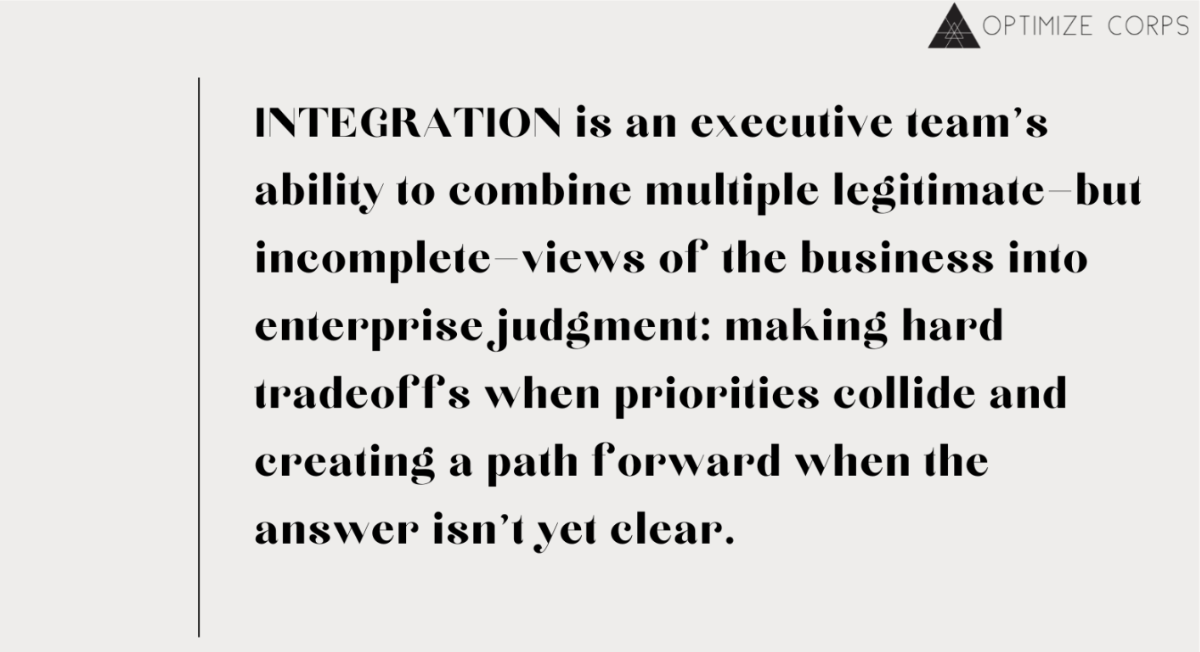
This isn't about getting everyone to think the same way. We need the CFO to see something the CRO doesn't. We need Product to bring a perspective Operations wouldn't have arrived at on its own.
The opportunity is for those different perspectives to actually change and expand how the team understands the problem.
Sometimes that gets the team to a difficult tradeoff. Other times, Sales brings one piece of the answer, Product brings another, Finance challenges an assumption neither of them realized they were making, and the team ends up somewhere none of them could have gotten on their own.
That's the 1 + 1 = 3 opportunity of an executive team.
So how do you build it?
I don't think you build integration by telling executives to collaborate more. And you certainly don't build it by simply asking them to "think enterprise." From my perspective, you start more intentionally.
First, the executive team has to become the First Team.
Executives need to understand that when they sit at that table, their accountability is bigger than the function they lead.
That doesn't mean everyone gets a vote on every functional decision. Because the problems that rise to the executive-team level are rarely solo jobs.
Instead we want to shift from How can I help you solve your problem? to What do we need to solve together?
Second, the team needs an enterprise operating lens.
If we want seven people to exercise enterprise judgment together, they need some shared basis for making those calls.
Can we see the enterprise together?
What are we actually optimizing for right now? What do we believe about the business and the environment we're operating in? What tradeoffs are we willing to make? Which assumptions sit underneath our strategy? What matters enough that we'd protect it under pressure? And what new information would make us reconsider?
This isn't about getting to a shared opinion. It's about having enough shared context that the differences in the room can actually be useful.
Third, the team has to believe it's responsible for the problem together.
This goes beyond changing the language from "Product's problem" to "our problem." The growth problem isn't Sales' to fix while everyone else watches. The roadmap problem isn't Product's to fix and report back on. The organizational capacity problem isn't something to hand to the CHRO.
Those leaders may own important pieces of the response. But many of the challenges that matter most to the enterprise simply cannot be solved by one function doing its job better. If the problem crosses the enterprise, the team has to own finding the answer, together.
And finally, the team has to get the reps in.
You can't wait until the Board hands you a seemingly impossible set of targets or your market changes overnight to learn how to do this.
Teams need to practice on the real decisions already in front of them.
That includes the CEO.
The CEO has context, judgment and pattern recognition the team needs. They absolutely belong in these conversations.
But the CEO belongs in the integration. They just can't always be the integration.
Every time the CEO listens to six perspectives, synthesizes them and hands the team the answer, the business problem may get solved. But the team hasn't necessarily gotten any better at solving the next one.
What changes when a team can actually do this?
The difference isn't that everyone suddenly agrees more. It's that the conversation starts to feel different.
A question from the CFO about the Product roadmap doesn't automatically feel like a challenge to the Product leader's expertise. The CRO can push on a Marketing assumption without the conversation becoming a turf war. Someone can say, "I don't think that's right," without it becoming a contest over who knows more or who has the authority to make the call.
The questions themselves change.
What are you seeing that I'm not?
What are we missing?
If what you're saying is true, what does that change about how we're looking at this?
What assumption are we making here that we should challenge?
Curiosity starts to replace cross-examination. You're not questioning someone's knowledge. You're trying to expand what the team knows.
People can also change their minds without losing face. Nobody needs to defend the quality of the answer they walked in with because the point is to leave with a better answer than any one person brought into the room.
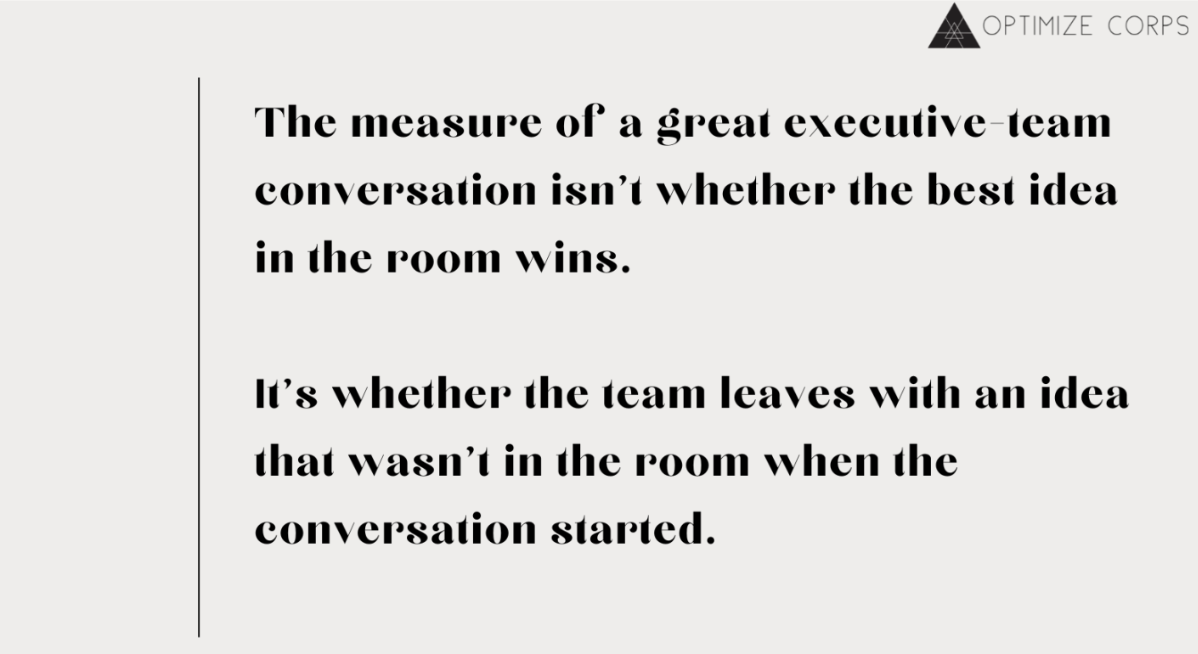
That's the collective intelligence we're after. And the benefit isn't just a CEO who can take a two-week vacation without decisions piling up. The organization has more capacity to solve hard problems because its smartest leaders can actually think together.
Two weeks ago, I wrote about the question we hear from CEOs all the time: Can I trust my team enough to step away? I think this is the other half of that question. The answer isn't simply to delegate more or trust your executives more. It's to build an executive team capable of holding more of the enterprise with you.
This is a core part of the work we do with executive teams at Optimize Corps. We use the real, consequential business challenges already sitting on the team's agenda to help them build this capacity together. The impossible target, the competing priorities, the problem with no playbook—those aren't distractions from developing the executive team. They're some of the best opportunities to do it.
So maybe the question for your next executive meeting is this:
Are we getting the value of the executives sitting around this table—or the value of the team they could become?